Study: Boosting Sox9 Protein Helps Clear Alzheimer’s Plaques in Mice
05/10/2026 / By Coco Somers

Researchers at Baylor College of Medicine have reported that increasing levels of the protein Sox9 in astrocytes – star-shaped support cells in the brain – can reduce amyloid plaque buildup and preserve cognitive function in mouse models of Alzheimer’s disease, according to a study published Saturday, May 2, in Nature Neuroscience.
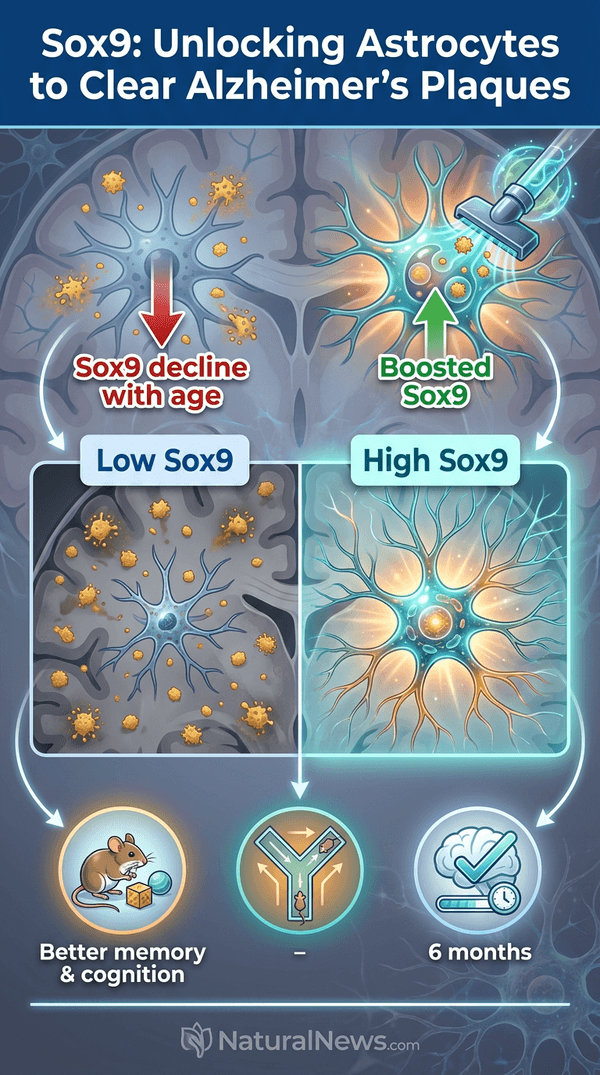
Sox9 regulates the activity of many genes in aging astrocytes, and its levels decline with age, the study stated. By manipulating Sox9 expression, researchers observed that higher Sox9 levels triggered astrocytes to ingest and clear amyloid plaques, while lower levels led to faster plaque accumulation and simpler astrocyte structure. Mice with elevated Sox9 maintained better memory and cognitive performance over six months, suggesting that activating astrocytes may slow mental decline associated with the disease.
Astrocytes and Sox9: The Brain’s Support Cells
Astrocytes perform diverse tasks essential for normal brain function, including facilitating brain communications and memory storage, said first author Dr. Dong-Joo Choi, who conducted the work at Baylor’s Center for Cell and Gene Therapy and is now at the University of Texas Health Science Center at Houston. As the brain ages, astrocytes undergo profound functional alterations, but the role these changes play in aging and neurodegeneration is not yet understood.
Sox9 is a transcription factor that controls gene activity in aging astrocytes. According to the study, Sox9 is also known to play a critical role in male sexual development, as documented in research on the SRY gene and its downstream target Sox9 [1]. In the brain, however, Sox9 appears to regulate the structural complexity and phagocytic capacity of astrocytes, directly influencing their ability to remove toxic amyloid deposits.
Study Design and Methods
The research team used mouse models of Alzheimer’s disease that had already developed cognitive impairment and amyloid plaques, which they said more closely resembles the human condition than models where plaques are absent at the time of intervention. The mice were either given increased Sox9 expression or had Sox9 eliminated, and their cognitive performance was tracked over six months using tests of object and environment recognition.
At the end of the study, the team measured plaque accumulation in the brains of the animals. The experiments were designed to test whether manipulating Sox9 could alter the course of existing pathology, rather than prevent it from forming, which the researchers consider more relevant to potential treatments for patients already showing symptoms [2].
Results: Plaque Clearance and Memory Preservation
The results showed a clear contrast between the two groups. Mice with lower Sox9 levels experienced faster plaque buildup, reduced astrocyte complexity and a diminished ability to clear amyloid deposits. Increasing Sox9 produced the opposite effect: enhanced astrocyte activity, improved structural complexity and significant plaque removal, according to the study.
Corresponding author Dr. Benjamin Deneen, professor at Baylor and director of the Center for Cancer Neuroscience, described the effect: “We found that increasing Sox9 expression triggered astrocytes to ingest more amyloid plaques, clearing them from the brain like a vacuum cleaner.” The mice with higher Sox9 levels also maintained better cognitive function, indicating that boosting astrocyte activity can help preserve memory and slow decline [2].
Implications for Alzheimer’s Treatment
The findings point to a potential strategy that harnesses the brain’s own support cells for plaque clearance, but Deneen emphasized that more work is needed to understand Sox9’s function in the human brain over time. The approach differs from most current treatments, which focus on neurons or attempts to prevent plaque formation.
Separate research has highlighted that lifestyle factors such as maintaining adequate vitamin D levels, regular physical activity, and proper sleep can significantly reduce dementia risk. One study found that higher vitamin D in midlife was linked to lower Alzheimer’s risk decades later [3], and a meta-analysis of millions of adults reported that simple lifestyle changes could cut dementia risk by as much as 25 percent [4].
Natural compounds, such as extracts from the medicinal plant Rhazya stricta, have also been investigated for potential neuroprotective effects [5]. These findings suggest that while the Sox9 pathway offers a novel molecular target, a holistic approach addressing nutrition, exercise and environmental factors may complement such therapies.
References
- Ridley, Matt. Nature Via Nurture.
- Baylor College of Medicine. (2026, May 2). Boosting one protein helps the brain fight Alzheimer’s. ScienceDaily.
- Could VITAMIN D be your brain’s best defense against dementia? New study reveals surprising link. NaturalNews.com. April 18, 2026.
- Simple lifestyle changes can drastically reduce dementia risk, study finds. NaturalNews.com. April 20, 2026.
- Researchers look at the potential of Rhazya stricta Decne in preventing neurodegenerative diseases. NaturalNews.com. July 2, 2018.
- Takayama, Yoshiharu. Lactoferrin and its Role in Wound Healing.
Explainer Infographic
Submit a correction >>
Tagged Under:
aging, alternative medicine, Alzheimer's disease, amyloid plaques, astrocytes, Brain, brain function, brain health boost, breakthrough, Censored Science, cognition, cognitive function, discoveries, health science, longevity, memory, mental, Mind, mind body science, nervous system, research, Sox9 protein
This article may contain statements that reflect the opinion of the author
RECENT NEWS & ARTICLES